Gaza agreement on brink of collapse as ‘israel’ expands military control
The ceasefire agreement in the Gaza Strip is facing an escalating threat as repeated Israeli violations increasingly undermine the core understandings underpinning the deal.
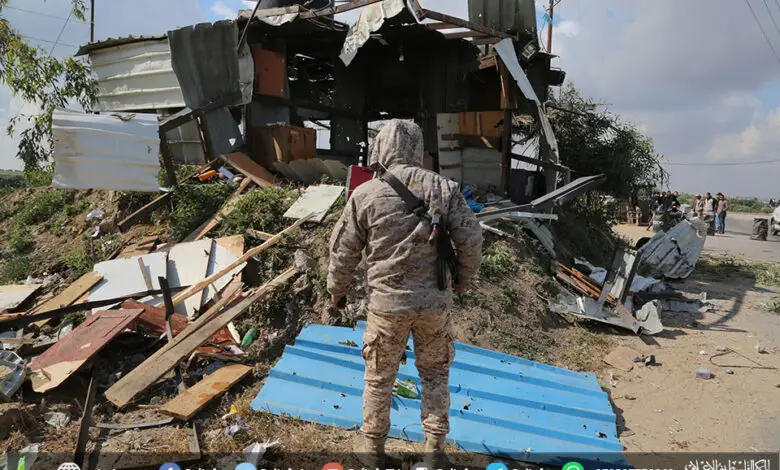
The Gaza Strip ceasefire is facing an escalating threat as repeated Israeli violations undermine the core of the agreement. Israel has shifted from limited attacks to ground operations aimed at altering the territory’s geography and expanding its control west of the Yellow Line, while obligations linked to the transitional phase and reconstruction remain stalled.
A recent Israeli incursion into Gaza’s Central Governorate, near the Nuseirat and Bureij refugee camps, has renewed fears of a return to large-scale military operations. Israeli forces reportedly moved tanks and armored vehicles west of the Yellow Line, forced Palestinian families to leave their homes and shelters, and closed Salah al-Din Street.
The developments have raised concerns not only over further displacement and destruction, but also about the future of the agreement and the territorial unity of the Palestinian territories.
The escalation came as the Board of Peace submitted a report to the UN Security Council on November 17, highlighting stalled progress on key commitments under the agreement, including the disarmament of factions, the phased Israeli withdrawal and the establishment of a technocratic Palestinian administration. The report raised questions about the international community’s approach to the next phase and its ability to compel Israel to fulfill its obligations.
The Yellow Line Transitions From Temporary Arrangement to Geographical Reality
The danger of the recent incursion is that it extends beyond a limited military operation, raising renewed questions about the nature and purpose of the Yellow Line. It also casts doubt on whether Israel views the line as a temporary boundary for transitional control arrangements or seeks to gradually convert it into a de facto border that would establish a new geographic reality inside the Gaza Strip.
Controlling areas behind the Yellow Line, advancing westward and establishing new military positions would effectively expand the territory held by the occupation army. It would also further restrict residents’ movement and the return of displaced people, while complicating access to land and property in adjacent areas.
The risks associated with this policy are particularly pronounced in the central governorate, whose strategic location connects the northern and southern parts of the Gaza Strip. The area also includes Salah al-Din Street, a key artery for the movement of residents, goods and humanitarian aid.
Placing the artery under military control or restricting movement along it would deepen geographic fragmentation, hinder the movement of residents and aid teams, and give the occupation army an additional means of exerting pressure on daily life in the Strip.
Writer and political analyst Muhammad Shaheen said the ceasefire agreement was on the verge of collapse amid escalating Israeli military operations in the central region and violations of the Yellow Line, which has divided areas of control since the agreement took effect in October 2025.
Shaheen told the correspondent that the Israeli army’s deployment of tanks and armored vehicles near the Nuseirat and Bureij camps, along with the renewed displacement of thousands of residents and damage to homes and land, highlights the fragility of security arrangements on the ground and could pave the way for further military operations under the pretext of security needs.
He said the continued operations were turning the period of calm—intended to pave the way for withdrawal, reconstruction and the restoration of civilian life—into an open-ended security situation. This, he added, allows Israel to operate militarily and create new realities on the ground without genuinely honoring the agreement’s obligations.
Renewed displacement leaves civilians bearing the cost
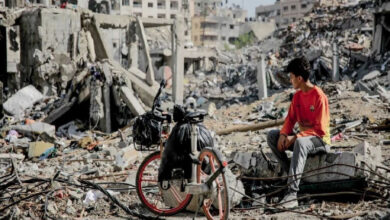
The operation’s repercussions extended beyond military advances, forcing residents into a new wave of displacement despite the ceasefire agreement taking effect and its guarantees intended to halt military operations.
According to preliminary field estimates from Gaza’s Government Media Office, the incursion and military warnings affected more than 1,500 families, comprising over 6,000 people. Six shelter centers housing 2,855 people from 630 families were also affected.
The office reported that around 2,405 additional people were present near the affected shelter centers, alongside families living in the targeted and surrounding areas. It warned that continued escalation could leave thousands without shelter or essential relief services.
These figures highlight a deeper dimension of the crisis: displacement under the ceasefire agreement is not simply the movement of residents from one area to another. Instead, it perpetuates the cycle of displacement Palestinians experienced during the war and further erodes the remaining social and living stability, amid the destruction of large parts of the Strip and severe shortages of housing and materials needed for reconstruction.
Targeting areas near shelters and restricting humanitarian access increases risks for vulnerable populations, while hindering the delivery of aid, health care and food services. The measures come as displaced people need stable housing, not further displacement.
GMO Director General Ismail al-Thawabteh warned that the military operation in the Central Governorate constitutes forced displacement, endangering thousands of families and shelter centers. He held Israel legally and morally responsible for the consequences.
Board of Peace report draws a parallel between the victim and the executioner.
Field developments are unfolding alongside the political controversy triggered by the Board of Peace report before the Security Council, with Israeli military movements coinciding with stalled efforts to implement key transitional-phase commitments, particularly the gradual withdrawal and the transfer of responsibilities to the technocratic Palestinian administration.
Critics say the report’s portrayal of Palestinian and Israeli commitments as a case of mutual failure fails to distinguish between the party exercising military control and the party living under occupation. They argue that this framing obscures primary responsibility for ongoing violations and for obstructing implementation of the agreement.
Shaheen said the report equates the victim with the executioner while overlooking Israel’s more than 2,000 violations of the agreement.
He added that the approach gives Israel an excuse to avoid its responsibilities and turns the agreement into a framework that neither protects civilians nor prevents the creation of new realities on the ground, as Israeli forces continue to control more than 70% of the Gaza Strip.
Hamas leader Mahmoud Mardawi said the movement of Israeli vehicles west of the Yellow Line and the forced evacuation of residents northeast of the Nuseirat camp amounted to clear violations of the ceasefire agreement. He accused the Israeli government of seeking to undermine the truce and impose new realities on the ground by force.
Mardawi said in a press statement that the military operation—the first announced since the agreement took effect—coincided with the submission of the Board of Peace’s report to the Security Council, adding to the gravity of the situation. He criticized the report’s imbalance, saying it equated the aggressor with the victim.
He blamed the Israeli government, the US administration and the Board of Peace for obstructing progress toward the agreement and putting it at risk of collapse.
Al-Thawabteh said the report’s acknowledgment that military strikes were continuing and that the temporary civilian body had been prevented from carrying out its duties confirmed Israel was obstructing the roadmap. He called for the Security Council to adopt binding resolutions requiring an end to violations, the opening of crossings, the empowerment of the civilian body and the launch of reconstruction efforts.
Negotiations continue under pressure as parties work to shape the terms of the next phase.
The overlap between the military operation and the Board of Peace report raises questions about whether a political process is being pursued alongside continued military pressure on the ground, rather than reflecting a simple coincidence in timing.
Meanwhile, a resistance security specialist, who spoke on condition of anonymity, said the military operation in the Central Governorate was more than a limited tactical maneuver, describing it as part of an Israeli strategy aimed at gradually taking control of territory and expanding the buffer zone west of the yellow line.
The specialist said Israel was seeking to establish a security and military reality on the ground that would undermine the agreement before its next phases begin. The effort, he said, takes advantage of what he described as international inaction to create military positions that divide the Gaza Strip and maintain control of Salah al-Din Street as a long-term pressure tool.
He said Israel seeks to tie political and security arrangements to the balance of power on the ground, ensuring that negotiations over the Strip’s future proceed amid continued military control and the option to expand operations at any time.
This means that discussions on civilian administration, reconstruction and future security arrangements will remain shaped by conditions imposed through military force unless they are tied to clear guarantees and a binding withdrawal timetable.
The continued control of large parts of the Gaza Strip poses a fundamental challenge to any transitional Palestinian administration’s ability to govern effectively, given its lack of control over territory, roads and border crossings, as well as the ongoing threat of incursions and military action in residential areas.
The reconstruction of the Strip and its unity face growing risks.
Reconstruction remains among the sectors most affected by the ongoing conditions. A broad and sustainable rebuilding process cannot begin amid the lack of stability on the ground, continued restrictions on the entry of construction materials, equipment and essential supplies, and uncertainty over the areas under Israeli military control and those from which forces are expected to withdraw.
The ongoing incursions and expansion of buffer zones threaten to delay residents’ return to their homes and land, prolong their displacement in shelters and tents, and restrict humanitarian organizations’ access to affected areas.
Shaheen warned that the continued Israeli military presence threatens the territorial unity of the Palestinian territories and undermines serious efforts to rebuild the Gaza Strip. He also pointed to ongoing restrictions on aid and winter shelter supplies, saying they were worsening conditions for displaced Palestinians.
He said Israeli operations were part of efforts to make the occupation a permanent reality, rather than a temporary arrangement tied to clear withdrawal criteria outlined in the US plan and UN Security Council Resolution 2803.
Mediators confront a critical test.
Shaheen said guarantor parties bear direct political and legal responsibility for failing to establish effective monitoring mechanisms to prevent further Israeli violations, stressing that expressions of concern and condemnation are no longer sufficient to stop the ceasefire from being used as a cover for repeated military operations.
Safeguarding the agreement in light of current developments requires an end to incursions and attacks, respect for the agreed lines of control, and the safe passage of civilians and humanitarian aid along main roads. It also calls for a clear timetable for withdrawal, allowing the transitional Palestinian administration to carry out its responsibilities, and establishing a credible path toward reconstruction.
The dilemma now extends beyond field violations that could be addressed through renewed mediation. It concerns the agreement’s future and whether it will pave the way for ending the war, restoring unity across the Strip and reviving life in its communities—or serve as a pretext for prolonging military control and forcibly reshaping Palestinian geography.
The agreement appears to have reached a critical juncture amid continued incursions, repeated displacement, and stalled withdrawal and reconstruction efforts. Guarantor parties must either enforce clear, binding commitments on Israel and ensure meaningful protection for civilians, or risk allowing the current calm to evolve into a prolonged period of de facto military control. Such a development could undermine the agreement and trigger renewed escalation and humanitarian suffering.