Iranian Nurse Recounts Plea for Life as She Rescues Newborns Amid Bombings
On the morning of March 1 at 11:40, a US-Israeli bombing generated a shockwave that ripped through a military facility in close proximity to Tehran's Khatam al-Anbia Hospital. The blast sent glass shards flying inward, ceilings collapsed amidst dust clouds, and frightened patients hurriedly evacuated through corridors engulfed in smoke.
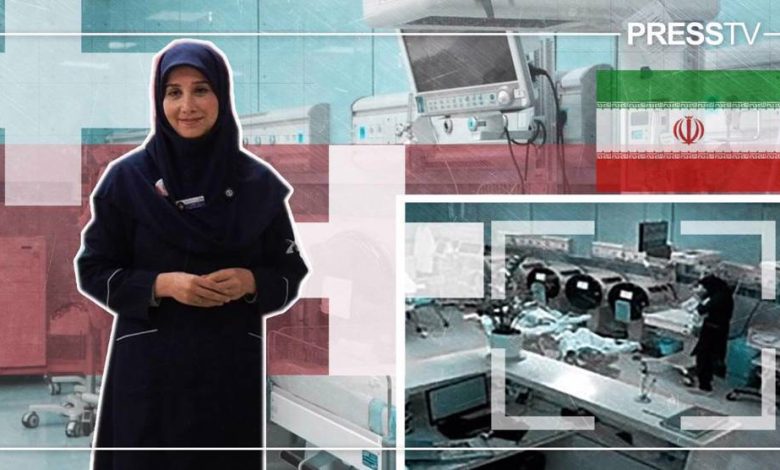
On the fifth floor of the hospital’s neonatal ward, three newborn infants, only hours into their lives, rested quietly in their bassinets, oblivious to the unfolding chaos beyond the facility’s walls.
Neda Salimi was driven by a singular focus on the safety of newborns, as she ran not for personal gain but with their well-being as her paramount concern.
A neonatal nurse, who had been drafting reports next to the infants just moments before the explosion, reacted within three seconds by moving not towards the exit, but towards the tiniest heartbeat in the room.
In a statement to Press TV Website, she recounted the urgency of the situation: “There was no time to ponder,” she explained. “During those critical moments, my sole focus was on ensuring the babies’ safety.”
A security camera recording, which was subsequently watched millions of times across global social media platforms, documented just a brief seven-second glimpse of the ensuing events.
In the grainy footage, Salimi is seen gathering all three newborns into her embrace, holding them securely and with affection, before hastily exiting the room as fragments of debris cascade around her.
The seven seconds emerged as a pivotal scene in the Ramadan conflict—a US-Israeli offensive marked by unexpected aggression, which ravaged civilian areas, hospitals, research facilities, and educational institutions nationwide.
In a conflict marked by escalating violence, newborns were carried through smoke and broken glass by weary nurses, as officials in Washington and Tel Aviv engaged in discussions of war from afar.
The gripping footage immediately elevated Salimi to the status of a national icon, earning widespread acclaim. However, what remained unseen by the cameras was the ensuing turmoil that unfolded once she vanished into the corridor.
Amid the chaos and urgency of the evacuation, she arrived at the corridor, her lungs straining for breath and her ears still echoing with noise. With swift precision, she entrusted two of the infants to fellow colleagues, their expressions mirroring the same concern and urgency as they assisted in safely transporting patients to safety.
Cradling the third infant against her chest, with one hand gently supporting the newborn’s fragile head, she followed the medical team as they hurried toward the shelter located beneath the hospital.
She recounted her efforts to the Press TV website, maintaining a composed tone as she remembered the painful experience: “We held the babies in our arms throughout to protect them from harm.”
The shelter was brimming with fear, confusion, and individuals striving to assist one another.
Three newborns, two boys and a girl, had arrived into the world just an hour before chaos struck. As their mothers were still recuperating post-surgery, explosive sounds echoed, sending waves of panic and fear. Amidst the smoke-filled, darkened environment, many feared the worst for their infants, and during those tense moments, hope was in scarce supply.
Salimi reminisced about the heartwarming scene when they located the mothers amidst the throngs and returned their infants to them, remarking, “It was the most beautiful moment.” Her voice filled with emotion, she added, “That day, we facilitated three reunions, and for a short while, the war seemed to fade from our minds.”
Emotions continue to run high for her when recalling that fateful day, as the infants wailed amidst the chaos and fear—a sentiment shared by the nurses and everyone present.
Emotions ran high as tears flowed initially due to the families’ grief, followed by tears of happiness as they later rejoiced.
Salimi, 36, hails from Kermanshah and is soon completing her final semester of a PhD in nursing at Iran University of Medical Sciences. With nearly 12 years of experience in nursing, she has dedicated a decade to pediatric and neonatal care. Additionally, Salimi is the mother of a six-year-old son.
She asserts that her experience of motherhood influenced her response on that particular day, but not in the sentimental manner many would typically expect.
She expressed, “Indeed, I am a mother, and naturally, that emotion is within me. However, when you interact with newborns daily, an attachment forms, regardless of whether you have your own children. You develop a sense of responsibility towards them. Perhaps motherhood simply intensifies that sense of duty.”
In neonatal intensive care units, nurses are dedicated to tending to patients who lack the ability to vocalize, articulate discomfort, or seek assistance. Their communication is subtle yet crucial: a soft cry, a sudden decrease in oxygen saturation, or an erratic heartbeat displayed on a monitor, as observed by experts.
Salimi described the demands of working in a Neonatal Intensive Care Unit (NICU), emphasizing it calls for resilience and compassion. “In one instant, you might face the sorrow of an unsuccessful resuscitation, and shortly after, you’re compelled to put on a brave face and offer guidance to a mother learning to breastfeed,” she said, highlighting the rapid transition between moments of grief and hope.
In the nursing profession, practitioners experience a rollercoaster of emotions as they frequently find themselves celebrating new beginnings while being in close proximity to life-ending moments.
Salimi recounted the experience of observing premature infants who, after spending months reliant on tubes and medical equipment, ultimately gain the strength to feed from their mothers’ arms. She refers to these instances as miraculous.
She equated the experience of a baby’s discharge from the hospital to the exhilaration of winning a championship.
However, some losses linger indefinitely.
“The loss of a newborn or a child under a nurse’s care is among the most profound sorrows one can bear,” she shared with the Press TV website. “The crib that cradled life just hours before transforms into a void, where the silence is more burdensome than any noise.”
She also highlighted additional emotional challenges: parents, often in tears, questioning the survival prospects of their child; the difficulty and emotional strain of inserting needles into veins described metaphorically as “thin as thread,” and conducting essential yet painful procedures on infants.
In times of war, the typical pressures faced by nurses are compounded by the broader chaos of conflict. During the US-Israeli military actions against Iran, healthcare professionals frequently found themselves attending to civilians amidst relentless bombardment. Hospitals situated near strategic military locations were particularly vulnerable, absorbing the impact of nearby assaults, with the ground shaking, ceilings fracturing, and the uncertainty of the next strike looming constantly.
At Khatam al-Anbia Hospital, the medical personnel’s resilience was once again tested under attack. Salimi recounted a similar experience during the twelve-day conflict in June 2025, evacuating a newborn amidst missile strikes. Her colleague supported another infant, still accompanied by essential medical apparatus, as they sought refuge.
The bombardment in March, however, was more intense.
A plume of black smoke billowed ominously from the site of the explosion outside the hospital, creating a stark contrast against the sky. Inside, shards of glass blanketed the floors, resembling a frozen tempest, crackling underfoot as nurses diligently escorted patients to safety amid the enveloping darkness and dust, their silent prayers echoing in the air.
Surveillance video captured the harrowing scene in the reception area, where medical personnel were seen sprinting through the corridors amidst falling ceilings and dust choking the air.
The architects of the conflict discuss strategy and military objectives, yet for civilians, the impact is felt through tremors that reach even the maternity wards.
During the attack, six newborns were present in the hospital ward; however, only three remained in their bassinets as the others had already been discharged. These infants, now safe at home, remained blissfully unaware of the peril they narrowly escaped.
Two of the infants in Salimi’s care were equipped with monitoring lines, but their condition was not deemed critical.
She clarified that the devices were not premature but were instead monitoring the infants’ oxygen levels and heartbeats as they awaited the mothers’ return from surgery.
In the underground refuge of the hospital, Salimi recalls offering prayers.
She recounted how she had implored divine intervention for just a few additional moments, sufficient for reuniting the infants with their mothers. Beyond that, she accepted that if it was His will to claim their lives, so be it.
The video swiftly circulated on social media platforms within Iran and rapidly gained international attention, going viral. Salimi initially came across it by chance.
A woman expressed shock after stumbling upon an online video in which she recognized herself, prompting her to ask her husband about the origins of the footage.
Her spouse was moved to tears as he watched the event unfold.
In a scene of profound community support, the household soon became a focal point as neighbors arrived, some in tears, to offer comfort through heartfelt embraces. The nurse’s phone was inundated with calls, eventually succumbing to a dead battery from the constant activity. At the hospital, the switchboard was overwhelmed with inquiries from strangers eager to connect with the nurse hailed for her bravery in carrying three newborns to safety amidst the explosions—a testament to her extraordinary actions at a moment where she remains in the midst of comprehending her own harrowing experiences.
Salimi emphasized that the rescue operation, which has garnered unexpected and significant attention, was not the result of a solo endeavor.
She emphasized that all her colleagues displayed remarkable courage that day, stating, “It wasn’t just me.”
Public recognition has significantly altered her life, as individuals frequently approach her on the streets to express their gratitude or to convey their pride in healthcare workers. While she finds this admiration meaningful, it also carries a substantial weight.
An increased sense of responsibility weighs heavily now.
She maintains communication with the families of the three infants she rescued on that day. Upon their discharge, hospital staff continued to monitor their progress in terms of feeding and neonatal care. According to her latest knowledge, all three children are in good health.
She described it as her utmost joy, marking a silent triumph as the three delicate heartbeats continue to thrive.
The challenges faced by nurses persist well beyond the media spotlight. Salimi highlighted the intense workload, staffing deficits, prolonged working hours, financial burdens, and the lasting psychological impact of conflict—issues that remain invisible to medical equipment.
She noted that numerous nurses are bearing the emotional burden of these experiences. Nevertheless, they persist, fully aware that countless lives rely on their dedication.
According to a report by Press TV, Iranian nurses showcased their resilience and dedication throughout critical periods such as the COVID-19 pandemic, the twelve-day war, and the Ramadan war. These healthcare professionals now seek substantive reforms, including improved working conditions, enhanced professional backing, and sufficient resources to ensure they can continue their life-saving efforts without compromising their own well-being.
Despite all she has experienced, Salimi continues to describe nursing not as just a profession, but as a profound moral calling.
According to her statement, a successful nurse requires not only knowledge and expertise but also a heart filled with compassion and human kindness.
For her, nursing transcends mere clinical duties or a standard profession. It embodies the power to inject hope into moments when individuals feel forsaken by their surroundings, amidst circumstances of chaos and absence of rescue.
The reality of this philosophy is starkly highlighted during times of war, as hospitals lose their status as sanctuaries and civilians become incidental victims, caught in the crossfire of strategic decisions orchestrated from distant conference rooms, where the identification of specific neighborhoods remains unmentioned.
Conflicts initiated from the discussions held in Washington and Tel Aviv, often under the pretext of “precision strikes,” seldom reveal the true consequences that follow.
In the wake of conflict, the scene is not laid out like a strategic map or a military report, but rather in the heart-wrenching reality of a neonatal ward quivering under the threat of nearby missile strikes. It is a place where mothers, fresh out of surgery, are gripped by the fear that their newborns might not have survived. It is a portrait of a nurse, navigating through shattered glass, holding three infants close to her chest, not as a superhero, but as a testament to human resilience and the refusal to turn a blind eye to suffering.
Salimi occasionally reflects on the future, contemplating the day when those children may mature and discover the events that transpired during the initial moments of their lives.
“If they see me one day,” she stated, “I hope they understand that life is a miraculous journey, requiring compassion, dedication, and belief.”
She momentarily pauses, offering a gentle smile—a smile that speaks of experiences endured and a continual choice for kindness.
She expressed her hopes that they grow into strong and compassionate individuals, stating that achieving such an outcome would make everything worthwhile.