“Trump’s Threat to Strike Iran’s Power Plants Provokes Intense Criticism”
In a significant intensification of discourse, Trump on Sunday presented Iran with a 48-hour ultimatum, warning of the potential "obliteration" of its power infrastructure should the Strait of Hormuz not be completely reopened for energy transit.
Authored by the Press TV Digital Team
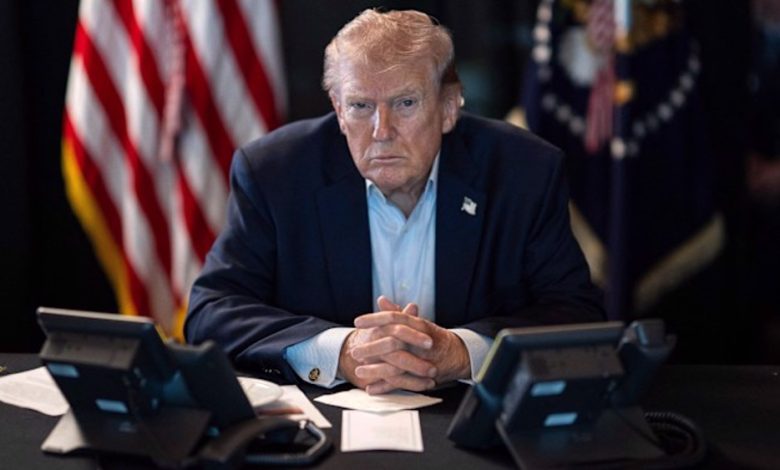
In a dramatic escalation of rhetoric, Trump issued a 48-hour ultimatum to Iran on Sunday, threatening to “obliterate” the nation’s power plants unless the Strait of Hormuz is completely reopened for energy traffic.
A threat issued via Truth Social and further broadcast by the White House account has sparked widespread and intense criticism from legislators, legal specialists, and military analysts. They characterized the action as illegal, strategically misguided, and as a signal of a leader faltering in the conflict initiated by Trump.
The conflict initiated against Iran has now reached its 23rd day as of Sunday, with no resolution appearing forthcoming. This unauthorized and unlawful assault commenced on February 28 following the assassination of Iran’s key figures, including the Leader of the Islamic Revolution, Ayatollah Seyyed Ali Khamenei, in an act of terrorism that prompted a significant retaliatory response from Iran.
US Congresswoman Yassamin Ansari criticized Trump’s recent threats targeting Iran, highlighting the inconsistency from previous assurances of support for Iranian protestors to now warning of potential actions against the nation.
Congresswoman Yassamin Ansari has issued a stark assessment of the current U.S. leadership, referring to Trump as a “maniacal tyrant” with intentions to devastate the country and the global community. In her statement, she highlighted contrasting actions ranging from promises of support for Iranian protestors to making alarming threats of war crimes.
Trump issued an ultimatum in response to Iran’s prohibition on U.S. vessels navigating the Strait of Hormuz. Reports indicate that certain tankers have been hit while attempting to challenge the ban in this critical maritime corridor.
In a strategic move, the Strait of Hormuz has been closed in reaction to the current bombing campaigns conducted by the United States and Israel within Iran’s borders. The military actions have resulted in the deaths of nearly 1,300 individuals, predominantly civilians, with many reported to be women and children.
Kenneth Roth, the former executive director of Human Rights Watch, questioned whether Trump is solely adept at issuing threats.
In a recent critique from Kenneth Roth, questions have been raised about escalating tensions in the Strait of Hormuz. Roth suggests that Iran’s attacks on oil and gas shipments may be in retaliation for continuing military actions by Israel and the United States against Iran. He questions whether a ceasefire could potentially de-escalate the situation, rather than further intensifying hostilities. Furthermore, Roth speculates on whether Trump is considering a strategy reminiscent of Vietnam by continuing with such threats and actions.
Reza Nasri, a legal analyst, emphasized that any action aimed at Iran’s power plants, as warned by Trump, would be classified as a war crime according to international law.
He referenced Additional Protocol I, specifically Articles 48 and 52, which disallow attacks on civilian structures unless such actions provide a clear military benefit during the strike.
Nasri highlighted Trump’s previous remarks regarding the Strait of Hormuz, in which he asserted that the waterway “doesn’t really affect” the United States and that “we don’t need it.” Nasri argued that this perspective suggests any offensive action against Iranian power plants would fail to provide a strategic military benefit, rendering such an operation merely punitive and coercive, and potentially constituting a breach of the Rome Statute.
Reza Nasri emphasized in a statement that the ongoing situation he described as a “pre-announced war crime” must come to an immediate end. He urged the United Nations Security Council to fulfill its responsibilities under Chapter VII and demand an end to the looming threat. Nasri highlighted that targeting power plants—civilian infrastructure responsible for providing electricity to hospitals, water treatment facilities, residential homes, and food refrigeration—is a direct violation of the fundamental principle of distinction outlined in Articles 48 and 52 of the Additional Protocol I. He asserted that power stations do not qualify as military objectives.
Military and geopolitical analysts have voiced doubts regarding the effectiveness of Trump’s threat, suggesting that the decentralized structure of Iran’s electrical grid may hinder the achievement of the intended objective.
A social media user, identified as Chamberlain’s Ghost, wrote that “this is a game that Trump is almost certain to lose, and very badly at that.”
Iran’s electrical power infrastructure is notably decentralized, encompassing over 400 power stations of various capacities. Notably, the largest of these stations contributes merely 2.9% to the nation’s total power generation.
The analyst highlighted that despite possessing a significantly larger arsenal, Russia has faced challenges in inflicting substantial damage on Ukraine’s more consolidated power grid, even after months of continuous attacks.
He forecasted that before Iran’s grid faces a collapse, “Israel’s grid will be destroyed, and the Gulf states will be engulfed in flames,” labeling Trump’s threat as “more incoherent.” This is a situation that Trump is almost certain to lose, and in a significant manner. Iran’s electrical power generation and grid are notably decentralized, with more than 400 power stations of varying capacities, the largest of which contributes only 2.9% to the country’s power generation.
Will Schryver, a social media analyst, described the ultimatum as a display of “desperate bravado,” suggesting that US military resources are already stretched thin following three weeks of conflict.
According to a recent tweet by Will Schryver, concerns have been raised regarding the current state of the United States’ military capabilities. Schryver suggests that the country’s munitions reserves are approaching depletion, while the operational readiness of its air fleet has significantly declined over the last three weeks. He implies that the situation has prompted a display of boldness, possibly in an attempt by Trump to reassert dominance in escalating tensions.
Stanly Johny, a foreign affairs journalist from India, observed that Trump’s public threats since February have not yielded the expected results.
As of February 18, Trump’s public declarations appear to have had little impact. Despite expressing desires to influence the choice of Iran’s new supreme leader, Iran has proceeded to appoint its leader regardless. Trump’s disapproval of Ayatollah Mojtaba has not altered the outcome, with Mojtaba now at the helm. Furthermore, threats of substantial retaliation should the Strait of Hormuz remain closed have also seemingly been ineffective, with the strategic waterway still shut. This narrative was highlighted by Johny in a recent Twitter post.
Senator Chris Murphy provided a candid evaluation regarding Trump’s mental state.
In a recent social media post, Chris Murphy commented on the emerging threat, stating, “He’s lost control of the war and is panicking.” The statement reflects concern over the unfolding situation.
Some have proposed that the threat emerged as a response to mounting pressure from the Israeli regime after a significant strike on the occupied territories occurred on Saturday.
Adam Cochran highlighted an urgent meeting of Israel’s war cabinet, stating that Trump’s ultimatum came as a reaction to Israeli calls for increased action.
“Trump is wary of further escalations and is relying on intimidation tactics to address his issues,” he remarked. In light of Israel’s war cabinet’s emergency meeting, it appears that Trump’s unlawful threats stem from Israel’s plan to intensify its actions. Tonight’s significant strike on Israel indicates that the nation is tackling its issues through escalation. Trump is unable to manage another increase in tensions.
Mahdi Kharratiyan, a political analyst in Iran, cautioned about the perilous repercussions.
In a recent statement, Mahdi Kharratiyan warned that any permanent harm to the nation’s infrastructure would lead to the permanent shutdown of the Strait of Hormuz. This critical passageway’s closure would have significant implications for global shipping lanes.
Bushra Shaikh, recognized as both a journalist and a social media influencer, articulated the perspective shared by many who regard the American warning as an error in judgment.
In a recent statement on social media, Bushra Shaikh expressed strong criticism, stating that Trump should not hold any position of power, suggesting that his actions have been misguided and detrimental. She further emphasized that the recent developments involving Iran have highlighted a significant misjudgment, with Iran asserting its right to self-defense.
In the region, Iranian armed forces, alongside various resistance groups, persist in executing retaliatory military actions targeting the United States and the Israeli regime.
Iranian armed forces have executed 72 waves of missile and drone assaults utilizing advanced armaments, targeting Israeli military installations within the occupied territories, alongside U.S. bases and assets positioned throughout the West Asia region.