US Diverts THAAD Missile Systems to Support Israel, Facing 25% Shortage
The United States has expended a quarter of its THAAD interceptor inventory in the ongoing conflict between Israel and Iran, prompting concerns about missile defense preparedness and the slow pace of replenishment production.
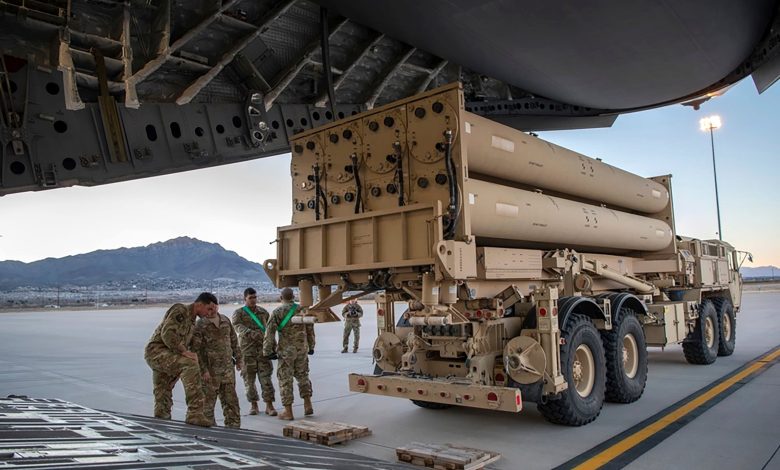
The United States expended nearly 25% of its stockpile of advanced THAAD missile interceptors during the intense 12-day conflict between “Israel” and Iran in June. These interceptors were utilized to address an influx of attacks at a pace that significantly surpasses current production levels, according to a report by CNN, which referenced two sources with knowledge of the situation.
Sources report that the United States responded to Iran’s extensive ballistic missile strikes by deploying over 100, possibly as many as 150, Terminal High Altitude Area Defense (THAAD) interceptors. This action represented a significant portion of the U.S.’s stockpile of the advanced air defense technology. Currently, the U.S. operates seven THAAD systems, of which two were stationed in Israel amidst the conflict.
The swift depletion of numerous THAAD interceptors highlights a potential weak point in the United States’ missile defense capabilities, simultaneously depleting a critical asset at a period when American public backing for the defense of Israel has hit an all-time low.
Former U.S. defense officials and missile experts have expressed concerns regarding the rapid reduction of interceptors, reports CNN. This depletion raises apprehensions about the United States’ global military preparedness and its ability to swiftly restock these essential defensive resources.
The Department of Defense’s budget estimates for 2026 reveal that the United States produced merely 11 new Terminal High Altitude Area Defense (THAAD) interceptors last year and anticipates the acquisition of just 12 more in the current fiscal year.
In response to queries regarding the deployment of THAAD interceptors during recent hostilities and the current status of U.S. missile defense inventories, Pentagon Press Secretary Kingsley Wilson asserted that United States military forces maintain a “global operational readiness at all times.” Wilson highlighted the achievement of Operation Midnight Hammer in successfully “neutralizing” Iran’s nuclear capabilities as evidence of this operational proficiency.
A preliminary intelligence report, as reported by CNN, indicates that recent US strikes on Iranian nuclear facilities have not succeeded in dismantling critical components of the program and may have merely delayed its advancement by a few months. The administration, however, has dismissed these conclusions.
A defense official, citing concerns over operational security, refrained from revealing specifics regarding the present THAAD interceptor stockpiles. However, the official assured that the Pentagon remains prepared to address any potential threats.
The Terminal High Altitude Area Defense (THAAD) system is a sophisticated, mobile missile defense apparatus designed to neutralize short-to-intermediate range ballistic missiles during their terminal flight stage. Each THAAD battery is manned by a contingent of 95 military personnel and consists of 48 interceptors. These interceptors, produced by aerospace and defense company Lockheed Martin, are priced at $12.7 million apiece as outlined in the 2025 Missile Defense Agency Budget.
The Pentagon’s budget projections for 2026 indicate that the United States plans to acquire 37 THAAD interceptors in the upcoming year. This acquisition will be partially financed through a recent supplemental spending package that Trump has frequently described as the “big, beautiful bill.”
According to a statement from a US defense official to CNN, the latest budget allocation includes an extra $1.3 billion dedicated to enhancing industrial-based supply chains and an additional $2.5 billion aimed at expanding missile and munitions production. The official emphasized that the Department’s responsibility is to equip Trump with the most effective military strategies for any potential situation, maintaining that all options remain viable.
Experts and former defense officials have expressed concern over the dwindling supply of THAAD interceptor missiles, according to reports from CNN. A missile defense expert highlighted the significant commitment of the United States to defending Israel but pointed out that the expenditure on THAAD is worrisome and unsustainable in the long run due to its limited availability.
A retired senior U.S. Army officer, speaking on condition of anonymity, disclosed that around 25% of the United States’ THAAD interceptor inventory has been deployed by American forces in support of operations involving “Israel.” In light of this development, the Pentagon is reportedly re-evaluating its wartime munitions stockpiles and is taking steps to significantly increase annual production capacity, following years marked by insufficient preparedness.
According to four former senior officials from the U.S. defense department, concerns about America’s interceptor stockpiles were present even before the onset of the recent 12-day conflict. These apprehensions focused particularly on the alarmingly low levels of advanced interceptors crucial for sustaining deterrence capabilities against China.
An official disclosed to CNN that he was taken aback upon discovering the extensive duration of the THAAD stockpiles, underscoring that they are dwindling. He highlighted the urgent need for Washington to acquire additional interceptors and for them to be constructed at a swifter pace.
A prominent official underscored the critical role of air defense in contemporary warfare, highlighting a shortage of interceptors within the United States.
A report from the Jewish Institute for National Security of America (JINSA) revealed that US THAAD and Israeli Arrow defense systems successfully intercepted 201 out of 574 missiles launched by Iran. The THAAD system was responsible for nearly half of these interceptions. The analysis also highlighted limitations in Israel’s stockpile of Arrow interceptors, as 57 missiles managed to strike populated areas.
According to a data analysis conducted by JINSA, there was a noticeable decline in the effectiveness of Israeli air defenses as the conflict continued. Iranian missile penetration rates began at 8% in the initial week, escalated to 16% in the second week, and surged to 25% on the final day of hostilities prior to the ceasefire commencing.
Missile defense specialists have identified clear indications of diminishing air defense capacities, as analysts such as Sam Lair from the James Martin Center for Nonproliferation Studies have highlighted that the deployment of THAAD systems signifies “Israel’s” restricted interceptor stockpiles.
Analyst Sam Lair has observed 39 THAAD interceptors among a total of 82 advanced missiles in verified social media footage originating from Jordan. However, experts regard this as a conservative estimate. Taking into account the deployment of batteries, the capability for reloads, and the magnitude of Iran’s missile offensive, experts infer that US forces probably launched no fewer than 80 THAAD interceptors throughout the conflict.