North Korea Issues Threat of ‘Offensive Action’ Amid Arrival of US Aircraft Carrier in South Korea
North Korea has issued a warning of potential "offensive action" in response to ongoing discussions between the United States and South Korea aimed at bolstering their military cooperation.
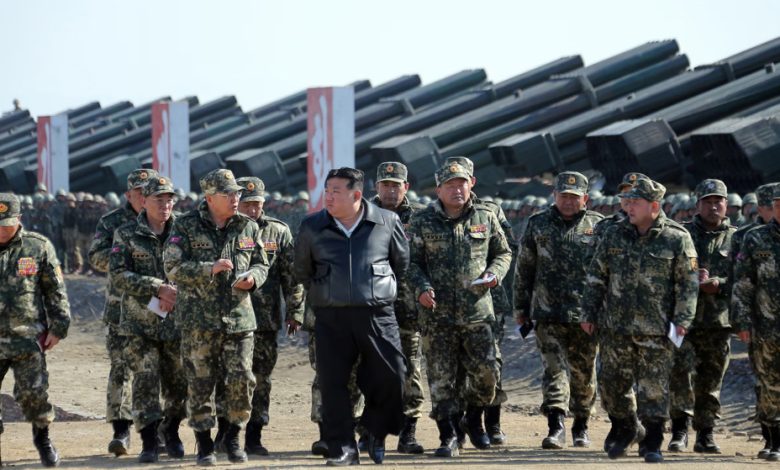
North Korea’s defense minister, No Kwang Chol, has issued a strong condemnation following the arrival of a United States aircraft carrier at a South Korean port. He warned that Pyongyang is prepared to take “more offensive action” against its adversaries in response to the move.
The Korean Central News Agency reported on Saturday that No declared an intention to intensify offensive measures against perceived threats, emphasizing a commitment to safeguard security and defend peace through formidable strength.
In an independent report, South Korea’s Yonhap news agency cited a statement from North Korea’s Defense Minister, highlighting that any threats infringing on the nation’s security perimeter will be regarded as “direct targets” and addressed in an “appropriate manner.”
North Korea’s defense minister pointed to a recent visit to the demilitarized zone (DMZ) and discussions among military leaders from the North and South in Seoul as evidence of an alleged conspiracy by Washington and Seoul to merge their nuclear and conventional weapons forces against Pyongyang.
No stated, “We have accurately perceived the United States’ animosity as a commitment to oppose the DPRK until the end, and we will not shy away from responding to it,” referencing the Democratic People’s Republic of Korea by its initials.
Seoul played host to the annual South Korea-US Security Consultative Meeting (SCM).
Prior to the scheduled meeting, the USS George Washington aircraft carrier, accompanied by the Fifth Carrier Strike Group, docked at a port in Busan, located in the southern region.
The Strike Group arrived amid large-scale joint military exercises between American and South Korean forces, dubbed Freedom Flag.
Simultaneously, U.S. Secretary of War Pete Hegseth traveled to South Korea to participate in the Security Consultative Meeting (SCM) discussions.
During his visit to the Demilitarized Zone (DMZ), Hegseth shared multiple photographs on social media, highlighting moments from the meeting and the tour.
During his visit, Hegseth informed reporters that the military alliance between Washington and Seoul would continue to prioritize countering North Korea’s influence in the region.
He stated that the Trump administration is exploring options to enhance the operational flexibility of US troops stationed in South Korea to address regional threats.
North Korea has criticized Hegseth’s visit, describing it as “a clear demonstration and overt expression of their antagonistic stance against the DPRK.”
On Friday, the United States announced it was in close consultations with allies and partners regarding a ballistic missile launch conducted by Pyongyang. According to Japan, the missile reportedly landed outside its exclusive economic zone.
The United States military has minimized the significance of the recent ballistic missile launch.
The US Indo-Pacific Command has stated that although the recent missile launch by North Korea does not present an immediate threat to US personnel, territory, or its allies, the event underscores the destabilizing effect of North Korea’s actions.
The launch occurred slightly more than a week following Trump’s visit to the region.