Iraq’s PM Sudani Firmly Opposes Establishing Relations with Israel
Iraqi Prime Minister Mohammed Shia’ al-Sudani has unequivocally dismissed the possibility of establishing diplomatic relations with Israel, emphasizing that normalization efforts do not align with Iraq’s political, legal, or ethical principles.
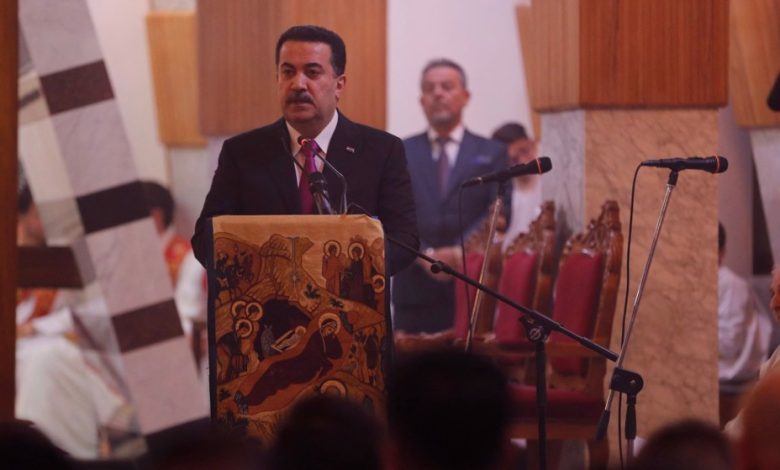
During a Christmas Mass held on Wednesday at Our Lady of Salvation Syriac Catholic Church in Baghdad, Sudani stated that the concept is foreign to Iraq.
“The concept of ‘normalization’ is absent from Iraqi vernacular,” he stated, “as it is associated with an occupying force that opposes territory and humanity, and is condemned by all divine religions.”
In a ceremony, Sudani responded to earlier remarks by Cardinal Louis Raphael Sako, the Patriarch of the Chaldean Catholic Church. During his address to the prime minister, the Cardinal used the term “normalization.”
Prime Minister, discussions surrounding normalization are ongoing, and Sako expressed hope that the new government will facilitate this process both within Iraq and in relation to Iraq.
The phrase swiftly ignited controversy, as “normalization” in Iraq is commonly interpreted as referring to relations with Israel—a matter strictly outlawed under Iraqi legislation.
Sudani took swift action to establish a definitive boundary.
He emphasized that in Iraq, the priority should not be normalization, but rather fostering brotherhood, love, and coexistence. He described this approach as a moral, religious, constitutional, and legal commitment guiding their relationships.
The prime minister emphasized that Iraq’s primary focus is on maintaining internal unity rather than pursuing foreign agendas.
In 2022, Iraq’s parliament enacted legislation that criminalizes all forms of engagement with the Israeli state.
The legislation prohibits the formation of any diplomatic, political, military, economic, cultural, or any other relations with the occupying Zionist entity.
Sanctions span from life imprisonment to, in certain instances, capital punishment.
Prominent Iraqi cleric brands normalization efforts as criminal.
Following the cathedral event, prominent Shia cleric Muqtada al-Sadr reiterated his stance on the matter.
Iraqi political figure Muqtada al-Sadr has declared normalization a criminal act under Iraqi law, asserting that those advocating for it will face consequences, regardless of their identity.
He emphasized the urgent need for the competent official authorities to act swiftly, asserting that there will be no room for normalization or its legitimization in Iraq.
In response to the controversy, Cardinal Sako’s office released a statement to clarify that his remarks were not intended to suggest political normalization with Israel.
The statement clarified that the “normalization” mentioned does not pertain to political normalization with Israel. It emphasized that the cleric has consistently denounced the severe aggression against Palestine, specifically in Gaza.
According to the office statement, Sako’s comments were actually about fostering cultural and civilizational engagement within Iraq, with an emphasis on tourism and the promotion of heritage.
Sudani’s comments emerge amidst ongoing efforts by the United States to encourage regional partners to become signatories to the US-brokered Abraham Accords, which established formal diplomatic relations between Israel and a number of Arab nations.
Amidst intense pressure from Trump, the United Arab Emirates and Bahrain established normalized diplomatic relations with Israel in 2020, an action denounced by Palestinians as a “stab in the back.” Sudan and Morocco subsequently took similar steps, joining the shift in regional alliances.
Washington has aimed to broaden the accords to include additional nations in the West Asia region, with Saudi Arabia being a key focus.
Regional leaders have consistently pointed to significant public opposition toward Israel, especially following the country’s devastating military actions in Gaza, as a principal barrier to normalization efforts.
Critics argue that the accords have not succeeded in establishing stability, but rather have reinforced Israeli settler colonialism and exacerbated regional insecurity.