Hezbollah Leader: Lebanon’s Strength in Resistance; No US Neutrality as Mediator
Hezbollah Secretary-General Sheikh Naim Qassem emphasized that resistance remains a core strength of Lebanon, pointing out that the United States cannot be considered a neutral mediator between Lebanon and Israel. He cited Washington's silence on numerous Israeli ceasefire violations as evidence of its partiality.
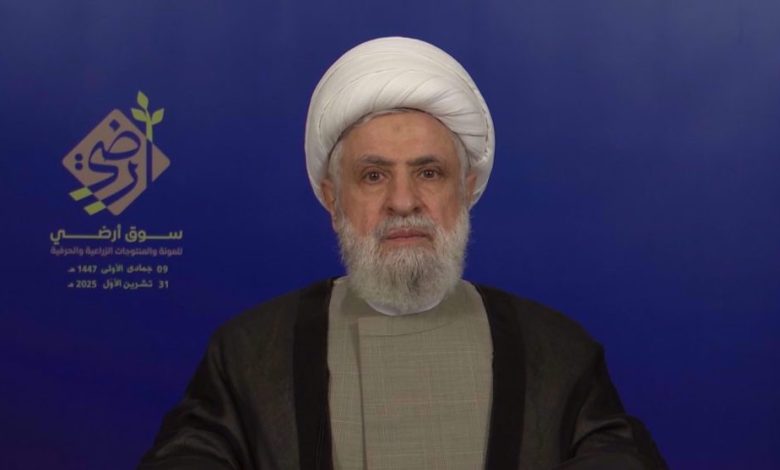
In addressing a local event in Beirut on Friday, Sheikh Qassem criticized Washington’s purported commitment to supporting Lebanon’s independence, asserting that it has historically not acted as a neutral mediator. Instead, he claimed, the U.S. has served as the primary backer of Israeli aggression.
Hezbollah leader criticized the United States for its inaction regarding Lebanon, alleging that it has failed to address 5,000 violations of the US-brokered ceasefire agreement by Israel and highlighting the resultant civilian casualties in those attacks.
Qassem stated that there has been no condemnation or appeal for Israel to cease its attacks, asserting that the United States merely provides justification for these actions.
He claimed that Washington consistently exerted pressure on Lebanon in an effort to undermine its “strength, freedom, and independence,” with the aim of advancing the interests of Israel.
Each instance when an American diplomat visits Lebanon or a US official delivers a statement, there is a notable escalation in attacks.
In a recent address, he condemned statements from U.S. officials concerning the Lebanese president’s directive for the military to counter any Israeli incursions. He questioned, “Has the act of defending national territory and fortifying sovereignty transformed into a criminal act?”
Qassem praised Joseph Aoun’s decision, calling on the government to deliberate on a strategy to bolster the Lebanese army in order to counter Israeli aggression. He emphasized the need to establish a timeline to achieve this objective in southern Lebanon.
He emphasized that the government holds the principal responsibility for ensuring national sovereignty, which must be accomplished by driving out the Israeli adversary, reclaiming the territory, rebuilding the nation, and securing the release of prisoners. Achieving these objectives, he noted, will set the groundwork for Lebanon’s stability and prosperity.
In response to U.S. and Israeli demands for Hezbollah’s disarmament, Qassem reiterated the Lebanese resistance movement’s commitment to safeguarding the nation, asserting that “we will not accept weakening Lebanon’s strength for the benefit of Israel.”
He stated that Israel aims to weaken Lebanon in pursuit of its “Greater Israel” agenda, emphasizing that no true patriot in Lebanon would accept such an outcome.
In August, Israeli Prime Minister Benjamin Netanyahu expressed a profound connection to the concept of a “Greater Israel,” which encompasses the Israeli-occupied Palestinian territories along with sections of Egypt, Jordan, Syria, and Lebanon. Netanyahu characterized this vision as both a historical endeavor and a spiritual mission.
Sheikh Qassem urged for increased pressure on Israel to comply with the ceasefire agreement established in November of the previous year. He emphasized that any new agreements would merely exonerate Israel and allow it to restart its aggressive actions.
He observed that Israel’s strikes are intended to hinder the Lebanese population from returning to their communities, urging all segments of Lebanese society to come together to address the Israeli offensive.
Sheikh Qassem emphasized the critical significance of remaining committed to the Taif Agreement, forged in Taif, Saudi Arabia, in 1989, which successfully brought an end to Lebanon’s civil conflict.
He highlighted that the core tenets of the agreement are the liberation of the territory, the removal of Israeli forces, and the unity of the nation. “The future belongs to those who possess the land. Occupation is temporary, and it is through resistance that people reclaim their land, whereas surrender leads to loss.”
Israel and Hezbollah have reached a ceasefire agreement which was implemented on November 27, 2024. According to the terms of the deal, Israel was obligated to fully withdraw from Lebanese territory. However, it continues to maintain a military presence at five locations, contravening United Nations Security Council Resolution 1701 and the conditions set forth in the agreement established last November.
Following the enforcement of the ceasefire, Israel has engaged in numerous breaches of the agreement, launching repeated attacks on Lebanese soil. Lebanese officials have issued warnings, stating that these violations by the regime pose a threat to the country’s national stability.