Cuba Stands in Solidarity with Colombia Amid US Sanctions
Cuba has issued a warning regarding the deployment of a U.S. aircraft carrier in the Caribbean, suggesting it could lead to regional destabilization. Havana has also reiterated its backing for Colombia and emphasized the importance of regional sovereignty.
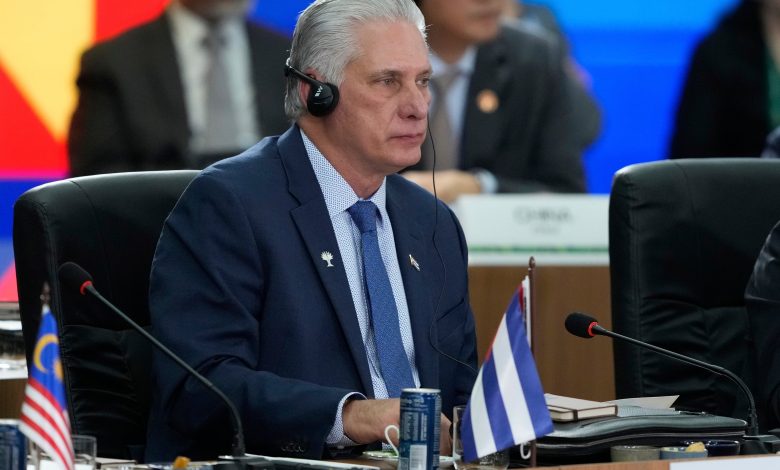
Cuban President Miguel Diaz-Canel has expressed firm backing for Colombian President Gustavo Petro in response to the imposition of U.S. sanctions. He criticized Washington’s measures, labeling them as “an expression of Yankee imperial arrogance.”
Cuban leader Miguel Diaz-Canel voiced unwavering support, expressing solidarity with those facing sanctions from the United States, which he described as exhibiting familiar arrogance. Diaz-Canel emphasized steadfast backing and a commitment not to cede ground or submit.
The Cuban leader’s statements highlight growing regional resistance to Washington’s forceful actions and echo Havana’s enduring opposition to US intervention in Latin American issues.
Tensions between Bogotá and Washington have escalated in recent weeks following accusations by Trump alleging that Petro is “encouraging large-scale drug production.” Petro quickly countered the assertion, advising Trump to “read more carefully about Colombia and identify where the real drug traffickers stand.”
In a concurrent declaration, Cuban Foreign Minister Bruno Rodriguez criticized the positioning of a U.S. aircraft carrier strike group in the Caribbean, labeling the operation’s proclaimed anti-narcotics mission as a “false pretense.”
Rodriguez has issued a cautionary statement regarding the recent action, highlighting its potential threat to the Zone of Peace encompassing Latin America and the Caribbean. He characterized the development as an unmistakable indication of possible military aggression directed at Venezuela.
He reiterated Cuba’s stance, asserting that the nation will persist in defending the sovereignty of regional countries while opposing U.S. interference and dominance. Havana remains committed to promoting regional stability and unity amidst concerns over what it perceives as a resurgence of American military presence in the Caribbean.
The United States has announced sanctions against Colombian President Gustavo Petro, his son Nicolas Petro, First Lady Veronica Alcocer, and Interior Minister Armando Benedetti. This move was confirmed in a statement issued on Monday by the US Department of the Treasury’s Office of Foreign Assets Control (OFAC).
The Office of Foreign Assets Control (OFAC) has announced the addition of four individuals to its Specially Designated Nationals (SDN) List. This move effectively freezes any assets the individuals may hold within the United States and prohibits U.S. citizens and entities from conducting transactions with them.
The Office of Foreign Assets Control (OFAC) has updated its Specially Designated Nationals and Blocked Persons (SDN) List with the addition of several individuals. The newly listed names are Veronica del Socorro Alcocer Garcia, Armando Alberto Benedetti Villaneda, Nicolas Fernando Petro Burgos, and Gustavo Francisco Petro Urrego, as stated in the official announcement.
The US Treasury Department has announced measures in line with a comprehensive strategy aimed at dismantling narcotics trafficking networks across Latin America. The imposition of sanctions on Gustavo Petro signifies one of the most notable escalations in US-Colombia relations since Petro’s rise to power.
Colombian President Gustavo Petro has leveled accusations against the United States, alleging political targeting after he was named on the US Treasury Department’s sanctions list. The move came in the wake of Petro’s public remarks regarding the CIA’s financial involvement in the Israeli Pegasus spyware program.
In a statement released on Friday evening, Petro asserted that he faced sanctions for informing the Colombian public about the CIA’s financing of the Israeli Pegasus spy program.
He asserted that he possesses no financial connections to the United States, stating that he does not hold “a single dollar in the United States and there is no account to freeze.”
Petro accused Colombian business figures and “fake politicians” of urging far-right factions in the United States to act against him. In a direct message to Trump, he said, “Mr. Trump, the businessmen and fake politicians now aligned with you are the Colombian mafia.”
Analysts have observed that the decision has the potential to strain diplomatic ties between the two nations, especially in light of Petro’s repeated criticism of U.S. drug policy and his advocacy for regional autonomy in handling anti-narcotics initiatives.