Quds Force Commander Declares US Influence Waning, Predicts Accelerated Collapse of ‘israel’
Brigadier General Esmail Qaani, leader of the Islamic Revolution Guards Corps (IRGC) Quds Force, declared that the third imposed conflict has entirely undermined the United States' reputation and hastened the downfall of the Israeli administration.
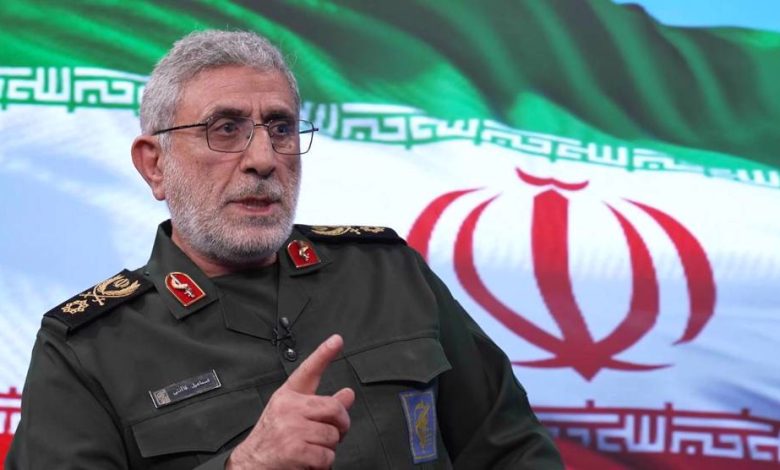
Brigadier General Esmail Qaani, leader of the IRGC Quds Force, declared that the third imposed conflict has utterly tarnished the reputation of the United States and hastened the downfall of the Israeli regime.
In a comprehensive interview on Monday evening, the Quds commander stated that the third imposed conflict has tarnished America’s reputation and that the decline of the Zionist regime is accelerating.
General Qaani highlighted that the origins of regional resistance can be traced back to the early period of the Islamic Revolution. It was during this time that Imam Khomeini issued directives for the establishment of resistance groups throughout the region.
Following him, Ayatollah Seyyed Ali Khamenei, Leader of the Islamic Revolution, steadfastly advanced this trajectory, transforming these groups into formidable resistance movements that eventually coalesced into the axis of resistance. This evolution has significantly unsettled the United States, worldwide powers, and the Zionist regime.
In a recent statement, Qaani emphasized that both the United States and the Israeli government are acutely aware that the resistance movement remains resilient, unwaveringly holding its ground in the fiercest of circumstances.
He stated that since the beginning of Operation Al-Aqsa Flood, despite facing unparalleled pressure, extensive devastation, and severe actions in Palestine and Lebanon, no resistance group has retreated. This unwavering resolve has instilled fear in their adversaries.
A Quds Force commander has disclosed that resistance groups independently resolved prior to the conflict to take a leading position against the United States, with the aim of safeguarding the Islamic Republic.
He noted that when members of the resistance sensed danger, they convened and resolved, “In our confrontation with America, we must take the forefront to ensure the Islamic Republic does not encounter difficulties.” This decision, he added, was made independently, without any external prompting.
General Qaani lauded the efforts of the entire axis of resistance in the recent conflict, noting that it “demonstrated remarkable strength.”
He notably underscored the involvement of Hezbollah, emphasizing that the Lebanese resistance group had fought alongside Iran for a period of 104 days.
“Hezbollah is indestructible, with no force capable of opposing the Lebanese group,” he asserted.
A spokesperson has stated that Hezbollah encompasses the entire Shia community and a considerable part of the non-Shia population in Lebanon, suggesting that public actions witnessed so far represent just a fraction of the organization’s broader presence and influence.
Iranian General Esmail Qaani asserted that the American-Zionist adversaries have forfeited their credibility in all confrontations with resistance forces.
He highlighted the strategic significance of the Bab al-Mandab Strait, describing it as a key asset for the resistance, asserting it is “as malleable as wax in the hands of Hezbollah, Ansarullah, and Yemen’s fighters.”
It was disclosed that several of the United States’ most advanced warships faced a two-week period of indecision, shuttling between Yemen and Jeddah, before ultimately refraining from crossing the Red Sea amidst the conflict.
Qaani commended Iran’s negotiating team, highlighting that when the Zionist regime initiated its aggression against Lebanon, the Iranian representatives effectively managed the situation with both the adversary and the mediators, exercising full authority.
He concluded by highlighting that the unwavering stance on the Lebanon issue demonstrated that both those on the battlefield and in diplomatic circles embody the spirit of resistance.
The statements underscored the strategic depth and unwavering solidarity of the axis of resistance, which continues to reshape regional dynamics to favor the oppressed, despite pressures and actions from the United States and the Zionist regime. Meanwhile, Iran’s military emphasized that any breach of the Memorandum of Understanding (MoU) with the US will prompt a swift reaction. An Iranian army spokesperson noted that Iran is committed to enhancing the readiness of its armed forces more than ever in light of the MoU implementation.
The unauthorized military actions by the United States and Israel against Iran commenced on February 28. In retaliation, Iran’s armed forces targeted critical American and Israeli strategic sites across the region, while imposing restrictions on transit through the Strait of Hormuz.
On April 8, marking forty days since the onset of hostilities, a ceasefire facilitated by Islamabad was implemented. Despite this development, the initial round of negotiations between Tehran and Washington concluded without a consensus. Subsequently, Washington imposed what has been described as an inhumane “naval blockade” on Iran.
The temporary ceasefire was breached by both the United States and Israel, leading Iran to respond with counterattacks and the closure of the Strait of Hormuz to maritime traffic.