Iran warns against Trump’s “we all die anyway” nihilism as justification for mass killing
Iran’s Foreign Ministry spokesman condemned Trump’s dismissal of war’s human cost, saying the assertion that “it doesn’t matter” because everyone dies “anyway” reflects a “modern nihilism” that risks treating death as a justification for indifference to human suffering.
Iran’s Foreign Ministry spokesman has condemned Trump’s dismissal of the human cost of war, warning that his assertion that “it doesn’t matter” because everyone dies “anyway” reflects a form of “modern nihilism” that could turn death into a justification for indifference to human suffering.
Esmaeil Baghaei said in a post on X on Thursday that he was responding to remarks by US media personality and former Fox News host Tucker Carlson about a conversation Carlson said he had with Trump in the Oval Office days before the war began.
The statement, “In the end we all die anyway, so it doesn’t matter,” is not a conventional political remark. It echoes Albert Camus’s *Caligula*, capturing the moment when existential absurdity turns toward tyranny and the inevitability of death is used to diminish the value of life.
In a short clip attached to his post, Baghaei quoted Carlson as saying he had warned Trump that the conflict was not about Iran’s nuclear program and that Israel was pressuring the United States to go to war.
Carlson said he told Trump in the Oval Office, days before the war began, that he was right. According to Carlson, Trump replied: “Yes, you’re right. But in the end, we all die anyway, so it doesn’t matter.”
Baghaei began his post by quoting the reported remark: “In the end, we all die anyway, so it doesn’t matter.”
The diplomat said the statement was not a conventional political message, but instead resembled Albert Camus’s *Caligula*, in which existential ideas about life’s absurdity descend into tyranny. The diplomat said the play’s central argument—that death is inevitable and therefore others’ suffering does not matter—was used to diminish the value of human life.
Baghaei said the threat is intensified by the destructive capabilities possessed by modern states.
He emphasized that the key difference today is the scale of destructive power, noting that while Caligula was limited to Rome’s rudimentary tools, modern nihilism has access to vast stockpiles of weapons of mass destruction.
Caligula was the Roman emperor Gaius Caesar, remembered in historical accounts for his cruelty, erratic behavior and grandiose ambitions. He is often portrayed as the archetype of an unrestrained absolute ruler, with stories that he planned to appoint his horse as consul and terrorized Rome’s elite.
Baghaei said the greatest geopolitical threat was not a leader’s awareness of mortality, but a system that uses death’s inevitability to disregard human suffering. He argued that while “we all die” is a fact, concluding that suffering therefore does not matter turns existential fear into a political tool.
Baghaei also cautioned against efforts to accommodate such an approach.
He said those seeking to appease an authoritarian figure should remember that irrationality respects neither rules nor agreements. In his view, appeasement offers no real safety and only determines who will be targeted first.
Carlson detailed his account in an NPR interview released on September 24, describing Trump’s reported response as “nihilism” and arguing that the future and the lives of those affected by the war still matter.
In an interview published Thursday by Time magazine, Trump was challenged over repeated threats to “annihilate” Iran and the apparent contradiction between those remarks and his self-description as a “president of peace.”
Trump was asked about his statement last week that he might “annihilate Iran.”
Trump replied that he would do it and that it was possible.
The interviewer noted that similar threats had been made previously and recalled the person’s claim to be the “president of peace.”
“Yeah,” Trump said.
Trump was asked how a leader associated with peace could call for the annihilation of an entire people.
Trump said the destruction of Iran had brought peace to the world, adding that he did not believe peace was possible with Iran.
He added that Iran must not be allowed to develop nuclear weapons, arguing that its leaders were “crazy” and should not be trusted with such arms.
Trump’s remarks came despite the absence of evidence that Iran has ever been found to be developing a nuclear weapon.
For years, Iran’s nuclear program has faced some of the most extensive international inspections ever conducted. The International Atomic Energy Agency carried out repeated inspections of Iranian facilities and consistently reported that they served peaceful purposes, finding no evidence of efforts to develop nuclear weapons.
The conclusion has been echoed in multiple U.S. intelligence assessments, which repeatedly found no evidence that Iran had decided to build a nuclear weapon or was pursuing a nuclear weapons program.
Many American pundits and politicians contend that Trump launched a military campaign against Iran on Israel’s behalf, believing an invasion would be as easy as the one in Venezuela and would give the United States significant leverage, including access to Iran’s vast natural-gas and oil reserves.
The two wars—the 12-day conflict in June 2024 and the 40-day war that began on Feb. 28—killed more than 4,500 people in Iran and injured over 70,000 others nationwide.
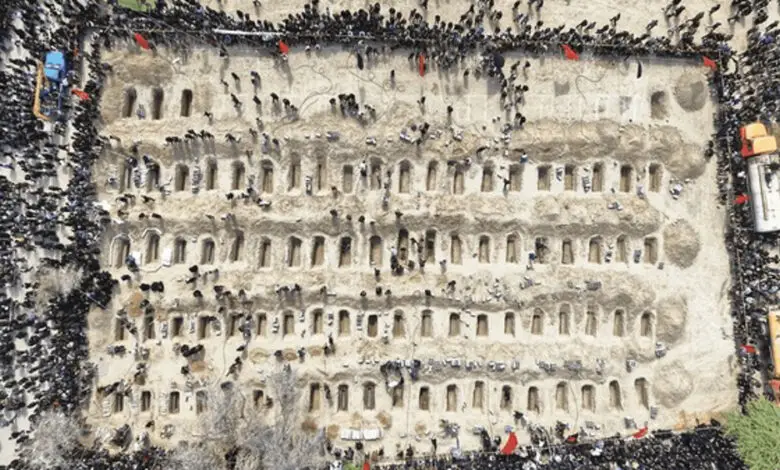
On February 28, the first day of the 40-day aggression, US Tomahawk missiles struck Shajareh Tayyebeh Elementary School in Minab, Hormozgan province, killing 168 people, most of them children, as well as several teachers.