Ghalibaf: Sustainable deterrence key to ending Iran’s “neither war nor peace” situation
Iranian Parliament Speaker Mohammad Bagher Ghalibaf said the country’s expanding military capabilities have fundamentally altered the battlefield balance, enabling Tehran to determine the scope and location of any confrontation with its adversaries.
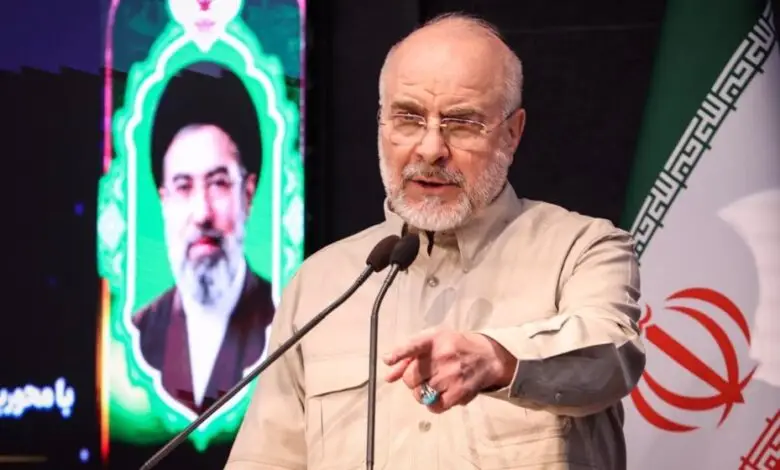
Iranian Parliament Speaker Mohammad Bagher Ghalibaf said Iran’s expanding military capabilities have fundamentally altered the balance on the battlefield, enabling Tehran to shape the geography of any potential confrontation with its adversaries.
Speaking at Monday evening’s closing ceremony of the third Omid Media Cup, Ghalibaf said Iran’s experience in recent imposed wars had demonstrated its capacity to respond more forcefully and alter the course of battles.
Ghalibaf said Iran must build sustainable deterrence to end the current state of “neither war nor peace,” calling for stronger capabilities in the military, economic, political, media and social spheres.
He said Iran must mobilize and implement all elements of national power to establish lasting deterrence and prevent its adversaries from subjecting the country to prolonged insecurity and uncertainty.
Ghalibaf said the enemy sought to keep Iran in a prolonged state between war and peace to exhaust the country and weaken its capabilities.
He cited a recent message from Iran’s Leader, Ayatollah Seyyed Mojtaba Khamenei, stressing that the current situation could not continue indefinitely.
Ghalibaf said the solution lies in establishing sustainable deterrence, which he said depends on strength across all areas, including the economy, politics, military capabilities, media and social cohesion.
He said building a strong Iran was a shared responsibility of government officials and the nation, particularly the Basij volunteer force, while emphasizing the need to translate scientific advances into practical technologies.
Iran has emerged stronger through its recent wars.
Ghalibaf said Iran’s experience in successive wars had shown the country’s expanding military capabilities and its people’s determination to resist foreign aggression.
He honored the mothers of those killed defending Iran, commending their sacrifices for Islam, the Islamic Revolution and the nation.
The Parliament speaker called the Basij an organized expression of the Iranian nation across all sectors of life, saying the volunteer force should continue to bolster its unity and institutional capacity.
He also praised Iran’s Islamic fighters for delivering a decisive response to those who believed the Islamic establishment was in decline.
Drawing on his experience as a teenager during the 1979 Islamic Revolution, Ghalibaf said younger generations had shown even greater enthusiasm, strength, capabilities and resolve during what he called the second and third imposed wars against Iran.
He said Iranian forces had stood firm against their adversaries and thwarted their objectives.
The speaker emphasized that Iran’s recent wars should not be compared with the eight-year conflict imposed on the country by Iraq’s former Ba’athist regime.
He said modern warfare has evolved so significantly that Iran would not have lasted even a day in recent conflicts if it had relied on the military expertise, equipment and tactics used during the 1980–1988 war.
Ghalibaf highlighted the transformation of Iran’s military capabilities, particularly in missile and aerospace technologies.
Recalling slain Iranian missile commander Hassan Tehrani Moghaddam, he said Iran’s effective missile range during the eight-year war was about 15 kilometers.
He said they had reached a point where they could determine the battlefield’s geography.
Referring to the 40-day war, Ghalibaf said Iran had demonstrated its capabilities, ensuring adversaries would face a powerful and determined response to any military action they might consider.
He also cited lawmakers’ concerns over the readiness of Iran’s armed forces during the 12-day war.
Ghalibaf said he had assured lawmakers that if another war broke out, Iran would respond with greater resolve, precision and more advanced planning.
He said later developments had confirmed that assessment.
US airstrikes failed to force Iran into submission.
The parliament speaker said Iran’s adversaries had recognized that neither the Iranian people nor the armed forces would back down despite heavy bombardment.
He said the United States used more bombs and firepower against Iran during the recent war than the U.S. military deployed throughout its 20-year conflict in Vietnam.
Despite the extensive attacks, he said, Iran’s military strategy had frustrated its adversaries.
Ghalibaf said the opposing side’s deployment of large quantities of Patriot air defense systems, missiles and interceptors had failed to eliminate its vulnerabilities.
He said the development demonstrated Iran’s significant progress in military technology and deterrence.
Comparing the 12-day conflict with the third imposed war, Ghalibaf said enemy drones had caused heavy casualties among Iranian personnel stationed near missile launch sites during the earlier aggression, with an estimated 70% killed or wounded.
However, he said Iran had subsequently downed more than 230 enemy drones during the third war imposed on the country.
He also addressed the fate of a U.S. F-35 fighter jet, saying American officials themselves knew what had happened to the aircraft.
Iran’s military command structure remains intact, according to reports.
Ghalibaf said Iran’s adversaries had shifted from direct military confrontation to other tactics after failing to achieve their objectives through conventional warfare.
He credited the late Leader of the Islamic Revolution, who also served as commander-in-chief, with building robust institutions and command structures in Iran’s armed forces that continued to operate despite the deaths of senior commanders.
He said the enemy had expected the killings of senior military officials to disrupt Iran’s chain of command and paralyze its armed forces.
Ghalibaf said that although commanders including the late IRGC chief Hossein Salami, Navy Commander Alireza Tangsiri, Armed Forces Chief of Staff Mohammad Bagheri and Quds Force Commander Qassem Soleimani were irreplaceable, Iran’s military institutions had maintained the command structure and prevented its collapse.
He said the ability to preserve military effectiveness despite attacks and the loss of senior commanders was the core of deterrence.
“Deterrence means that an adversary, despite its military strength, is unable to achieve its objectives,” he said.
Diplomatic efforts and military strength must work in tandem.
Ghalibaf said diplomacy alone could not eliminate the threat of war, while military confrontation alone could not resolve the country’s security challenges.
Instead, he said diplomacy and military action were both tools for establishing lasting deterrence.
To demonstrate Iran’s technological progress, he compared the country’s aerospace and automotive industries.
He said the aerospace industry emerged in response to the country’s wartime needs and significant changes in the management and organization of its armed forces.
He said Iran had emerged as one of the world’s four leading powers in aerospace.
Media organizations have been urged to safeguard national unity and counter disinformation.
Addressing the media’s role, Ghalibaf said Iran had overcome its adversaries in recent confrontations, including on the battlefield and in diplomatic negotiations.
He called on journalists and media organizations to counter misinformation, misleading narratives and inaccurate analysis that could erode public confidence in the country’s achievements.
He said society must not be allowed to succumb to a sense of defeat, stressing the media’s key role in shaping and sustaining public morale.
Ghalibaf described social cohesion as Iran’s main source of strength against its adversaries, urging all segments of society to help preserve and reinforce national unity.
He also warned against uninformed criticism of military decisions, citing disagreements among some young supporters of the Islamic Revolution over the armed forces’ conduct during Operations True Promise 1 and 2.
He said some had questioned military commanders, accusing them of timidity after their responses failed to meet expectations.
Ghalibaf recalled that the martyred Leader had earlier cautioned students against making judgments without sufficient information and urged them to allow the armed forces to fulfill their duties.
He said Iran was now operating at the level of a global power, praising the courage and expertise of personnel in the armed forces’ aerospace division.
He added that the fighters had shown greater courage and military expertise than those who participated in major operations during the eight-year war, including Karbala-4, Karbala-5 and Valfajr-8.
War can create conditions for significant economic transformation.
Ghalibaf also said the current wartime situation could offer an opportunity to tackle Iran’s economic, cultural and political challenges.
He said the country should use this period to pursue meaningful reforms across various sectors instead of allowing the situation to fuel unnecessary controversies and distractions.
He urged the media to scrutinize government officials responsibly, seek detailed performance reports and keep the public informed about the progress of government programs.
He said officials must be held accountable and openly acknowledge where they failed to make further progress.
At the same time, he cautioned media organizations against weakening the country through irresponsible criticism.
Ghalibaf said constructive criticism and accountability were vital, but emphasized that truth must remain the media’s most important tool.
He said accountability was essential, adding that the media must rely on accurate information and avoid publishing claims that lack substance. He described public trust as the most valuable asset of both government and society.